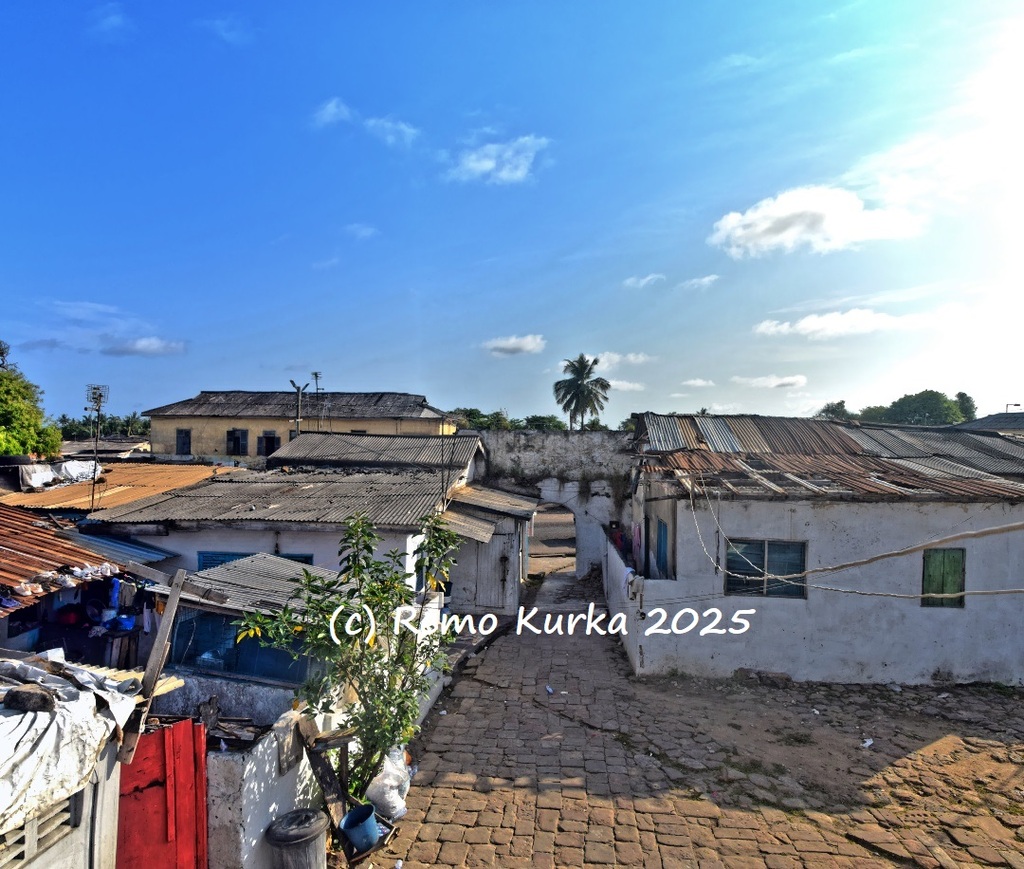
Together, these two men — Bannerman and Richter — commanded a slave militia of 600 people — six hundred human beings armed and used to secure trade routes and power. Compare that to the sixty soldiers the British and Danish forts combined could muster. Their power did not come from Europe. It was built here, on our soil, with our people as the currency.
The Comfortable Lie — and the Uncomfortable Truth
Today, you will see social media images claiming to show Bannerman — all fake. You will hear him described as a "pioneering leader," a "founding father," a bridge between worlds. What you will rarely hear is this:
- He opposed emancipation because it threatened his wealth
He married Yaa Hom, an Asante princess captured in war — a union that gave him access to trade networks deep into the interior, networks that fed the trade in captives
- He became Lieutenant-Governor of the Gold Coast in 1850 — sitting in the very castle we now visit — a man who used public office to protect private interests built on enslavement
- Richters Fort operated as a private trading hub where the line between merchant and master vanished entirely — where neighbours were bought and sold not by strangers from across the sea, but by families living right here in Osu
This history matters now more than ever. When leaders demand compensation only from Western nations — while remaining silent about the African kings, merchants, and families who captured, held, and sold human beings — they are not seeking justice. They are performing theatre.
It is true that European powers designed and expanded the trans-Atlantic system. It is true that their ships carried millions across the ocean. It is true that they profited most. But it is also true — and we must not flinch from saying it — that the trade could not have thrived without African participation. The captives were marched to the coast by African intermediaries. They were sold by African merchants. They were kept in bondage by African elites who fought to preserve the system even as Europeans moved to end it.
To demand payment only from the West while erasing our own history of complicity is not honesty. It is convenience. It allows those who benefit from silence to keep their hands clean while pointing fingers across the ocean.
Healing Starts When We Stop Lying
We do not tell this story to shame. We tell it to stop the lying.
We do not honour the dead by pretending only strangers harmed them.
We do not build a just future by selecting only the parts of history that serve our pride.
We do not claim the moral high ground by demanding what is owed while refusing to examine what was done.
James Bannerman and Henry Richter were not cartoon villains. They were people — complex, ambitious, ruthless — who chose profit over kin. That is the uncomfortable truth. Their descendants walk among us. Their legacy shapes our institutions. And until we can look that truth in the face — fully, without editing it — we are not truly free.
The castle stands. The sea still watches. The truth waits — not for those who will speak what is easy, but for those who will speak what is necessary.
Welcome to Christiansborg Castle. Not to be comforted — but to be honest.
Sources & Further Reading
(All links listed clearly for research and verification.)
The Nana Project – “Richter Fort: A Site of Enslavement and Contested Histories in the Heart of Osu, Accra”
https://www.thenanaproject.org/written-stories/richter-fort
Journal of Modern Slavery – Collins Quartey: “The Ghost at the Junction: Exploring the Links Between Historic and Modern Slavery in Accra, Ghana”
https://slavefreetoday.org/journal_of_modern_slavery/v7i1a3-the-ghost-at-the-junction-exploring-the-links-between-historic-and-modern-slavery-in-accra-ghana.pdf
The World (PRX) – “Slavers in the family: What a castle in Accra reveals about Ghana’s history”
https://theworld.org/stories/2019-08-19/slavers-family-what-castle-accra-reveals-about-ghanas-history
Arts Ghana – “Descendants of slave traders excavate Christiansborg”
https://artsghana.net/descendants-of-slave-traders-excavate-christiansborg
Quartz Africa – “Ghana’s Danish Osu Castle and its role in the slave trade”
https://qz.com/africa/1476624/ghana-s-danish-osu-castle-its-role-in-slave-trade